Blog

VW Atlas vs. Atlas Cross Sport: What’s the Difference?

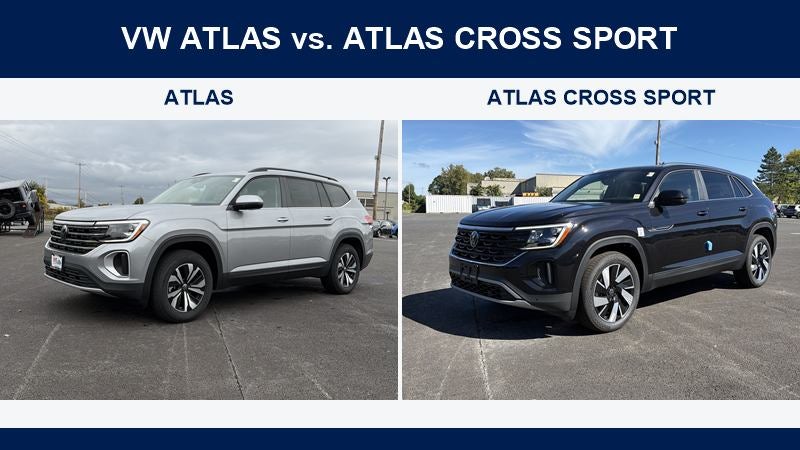
Comparison image showing a silver Volkswagen Atlas and a dark Volkswagen Atlas Cross Sport from Romeo Volkswagen of Kingston’s inventory.
The biggest difference between the 2026 Volkswagen Atlas and Atlas Cross Sport is seating. The Atlas has three rows and seats up to seven. The Atlas Cross Sport has two rows, seats five and features a more sloped roofline.
For Hudson Valley drivers, the choice starts with how you use your SUV. Do you need extra seats for carpools and visiting family, or would you rather have a five-seat layout with a sportier profile? Here’s how to compare them at Romeo Volkswagen of Kingston.

Which Volkswagen SUV has a third row?

The Atlas is the choice if you need a third row. Its seating for up to seven gives you flexibility for school runs, family outings and trips with friends.
The Atlas Cross Sport has no third row. It suits drivers who need space for five people and prefer a two-row cabin.
Think about your busiest week when deciding. If you regularly carry more than five people, the Atlas gives you seating the Cross Sport cannot provide. If those extra seats would usually stay folded, compare the Cross Sport’s layout before making your choice.

Do the 2026 Atlas and Atlas Cross Sport have the same engine?

Yes. Both use a turbocharged 2.0-liter four-cylinder engine producing 269 horsepower and 273 lb-ft of torque.
That shared powertrain means choosing the Cross Sport does not require stepping down to a less powerful engine. Seating, cargo layout and exterior design are the more useful starting points for your comparison.
During your test drive, take both on a similar route. Try local traffic, a highway merge and a parking maneuver so you can compare visibility and how each vehicle feels from the driver’s seat.

How does cargo space compare?

The 2026 Atlas provides up to 96.6 cubic feet of cargo space with the rear rows folded. Its third row lets you switch between carrying more passengers and making room for larger items.
The 2026 Atlas Cross Sport offers 40.3 cubic feet behind the second row and 77.6 cubic feet with that row folded.
The practical question is how much space you need while your passengers are seated. A maximum cargo figure assumes rear seats are folded, so it does not represent the luggage space available with every seat occupied.
Bring your stroller, sports equipment or other everyday gear when you visit. Checking the cargo opening and load floor can tell you more than measurements alone.

Can both SUVs tow?

Both 2026 models offer up to 5,000 pounds of braked towing capacity when properly equipped.
Before choosing either SUV for a trailer, confirm the equipment and towing limits of the exact vehicle. Account for the trailer’s loaded weight, passengers, cargo and tongue weight. A model’s maximum towing rating does not mean every configuration can tow that amount.
Our team can help you identify the equipment on a vehicle you’re considering.

Is 4MOTION all-wheel drive available?

4MOTION all-wheel drive is available on both models, with availability depending on trim and configuration.
For drivers around Kingston, Woodstock and the surrounding Hudson Valley, an AWD-equipped SUV may be worth considering for changing road conditions. Check the individual vehicle listing to confirm its drivetrain.
Remember that all-wheel drive does not replace appropriate tires or careful driving in snow and ice.

Which one fits your household?

Choose the Atlas if you:
  • Need seating for more than five people.
  • Carpool regularly or often travel with extended family.
  • Want the flexibility of a folding third row.
  • Prioritize maximum cargo capacity with the rear seats folded.
Choose the Atlas Cross Sport if you:
  • Need seating for five.
  • Prefer a two-row interior.
  • Like a more sloped, coupe-inspired roofline.
  • Want substantial cargo room without a third row.
If you’re considering the Atlas for family use, try the third-row access during your visit. Bring your child seats and check the seating arrangement you would use every day.

Compare both at Romeo Volkswagen of Kingston

The best way to decide is to sit in both SUVs and test them back to back. Check your driving position, rear-seat comfort, cargo access and visibility before choosing a trim.
Visit Romeo Volkswagen of Kingston at 1249 Ulster Ave, Kingston, NY 12401, or call 845-336-5300 to arrange your visit.
You can browse new Atlas inventory, shop Atlas Cross Sport inventory, explore current Volkswagen specials or start a trade-in appraisal online.

Frequently Asked Questions

Does the Atlas Cross Sport have a third row?

No. The Atlas Cross Sport has two rows and seats five. The Atlas has three rows and seats up to seven.

Which has more maximum cargo space?

The 2026 Atlas offers up to 96.6 cubic feet with the rear rows folded. The 2026 Atlas Cross Sport offers up to 77.6 cubic feet with its second row folded.

Do both 2026 models have the same horsepower?

Yes. Both have a turbocharged 2.0-liter four-cylinder engine rated at 269 horsepower and 273 lb-ft of torque.

Can both tow up to 5,000 pounds?

Yes, when properly equipped. Confirm the exact vehicle’s equipment and limits before towing.

Is all-wheel drive available on both?

Yes. Both offer available 4MOTION all-wheel drive. Check the trim and individual vehicle configuration.

Recommended Posts

America’s 250th Anniversary: Celebrating 250 Years of Freedom, Innovation & the American Drive

America’s 250th Anniversary: Celebrating 250 Years of Freedom, Innovation & the American Drive

A Once-in-a-Generation Celebration of America—and the Vehicles That Helped Move Us Forward In 2026, the United States will celebrate America’s 250th anniversary, also known as the Semiquincentennial. This historic milestone marks 250 years since the signing of the Declaration of Independence in 1776. Across the country, communities, families, businesses, schools, and local organizations will come together to celebrate American history, reflect on how far we’ve come, and look ahead to the future. For those of us in the automotive world, America’s 250th anniversary is also a perfect time to look at something that has been central to American life for generations: the automobile. From horse-drawn wagons and dirt roads to gas-powered engines, family SUVs, electric vehicles, advanced safety systems, and high-tech driver assistance features, the American driving experience has changed dramatically. Cars have helped families travel farther, businesses grow faster, communities connect more easily, and generations of drivers experience freedom on the open road. As we celebrate 250 years of America, we’re also celebrating 250 years of movement, progress, invention, and the drive to keep going. From Horse and Buggy to Horsepower Before cars filled driveways and highways, most Americans relied on horses, wagons, carriages, walking, trains, and eventually bicycles to get around. Daily travel was slower, more difficult, and often limited by weather, terrain, and distance. Then came the rise of the automobile. The early gas-powered vehicle changed everything. It gave people more independence, made travel more personal, and helped shape the modern American lifestyle. Suddenly, families could visit relatives in other towns, workers could commute farther, and small communities became more connected to larger cities and markets. The automobile did more than move people. It changed America. Highlights in the Evolution of the Automobile Here are just a few major ways vehicles have progressed over the years: Horse-drawn transportation: Before the automobile, horses and wagons were the everyday standard for many families and businesses. Gas-powered engines: Internal combustion engines gave drivers more speed, distance, and independence. Mass production: Assembly-line manufacturing helped make cars more affordable for everyday Americans. Electric starters: Early drivers once had to hand-crank engines. Electric starters made vehicles easier and safer to operate. Closed cabins and heat: Cars became more comfortable and practical in all kinds of weather. Automatic transmissions: Driving became easier and more accessible for millions of people. Power steering and power brakes: Larger vehicles became easier to handle. Air conditioning: Road trips became much more comfortable, especially during the summer. Seat belts, airbags, and crash testing: Safety became one of the biggest priorities in automotive design. SUVs, trucks, and family vehicles: Cars evolved to fit work, family, recreation, towing, travel, and everyday life. Hybrid and electric vehicles: Today’s vehicles are becoming more efficient, more advanced, and more connected. Driver assistance technology: Features like backup cameras, blind spot monitoring, lane keeping assist, adaptive cruise control, and automatic emergency braking are changing the way we drive. Cool Car Features That Changed the Way Americans Drive Over the decades, certain vehicle features became turning points in automotive history. Some were created for convenience. Others were designed for comfort, safety, or performance. Today, many features we take for granted were once major innovations. The Electric Starter Early vehicles often required a hand crank to start the engine. That could be difficult and even dangerous. The electric starter helped make cars more practical for everyday drivers and opened the door for wider vehicle ownership. The Automatic Transmission Manual shifting was once the standard. The automatic transmission made driving easier, especially in traffic and city driving. It also helped make vehicles more approachable for a wider range of drivers. Automotive Air Conditioning Today, we barely think twice about turning on the A/C. But when air conditioning first appeared in vehicles, it was a luxury. Over time, it became one of the most appreciated comfort features, especially for family road trips and summer driving. Seat Belts and Airbags Vehicle safety has come a long way. Seat belts, airbags, crumple zones, crash testing, and stronger vehicle structures have helped protect drivers and passengers for generations. Backup Cameras Backup cameras are now common in modern vehicles and have become an important safety feature. They help drivers see behind the vehicle, making parking, backing up, and navigating tight spaces easier. Touchscreens and Connected Technology Modern vehicles now offer features that once sounded futuristic: touchscreen displays, smartphone integration, navigation, voice commands, wireless charging, remote start apps, and over-the-air updates. Hybrid and Electric Vehicles The latest chapter in automotive history includes hybrid, plug-in hybrid, and electric vehicles. These vehicles continue the story of innovation, giving drivers new ways to think about efficiency, performance, and the future of transportation. America’s Love Affair with the Open Road Few things feel more American than a road trip. For generations, cars have been part of some of life’s biggest moments: Bringing a new baby home from the hospital Taking family vacations Driving to a first job Heading off to college Buying a first car Towing a camper, boat, or trailer Taking the scenic route just because Visiting grandparents, friends, and favorite hometown places Driving in parades, community events, and holiday celebrations As America celebrates 250 years, vehicles remain deeply connected to our memories, our milestones, and our sense of freedom. The Road Ahead: What Will the Next 250 Years Bring? As we look toward America’s future, the automobile will continue to evolve. Vehicles are already becoming safer, smarter, more efficient, and more personalized. The next generation of cars may bring even more advanced electric technology, improved battery range, expanded charging networks, enhanced driver assistance systems, and new ways for drivers to stay connected. But one thing will remain the same: people will still need vehicles that fit their lives. Whether it’s a reliable sedan, a rugged truck, a family-friendly SUV, a hardworking commercial vehicle, a sporty performance model, or an electric vehicle built for the future, the automobile will continue to play a major role in how Americans live, work, travel, and connect. Celebrating America’s 250th Anniversary Locally America’s 250th anniversary is not just a national celebration. It is also a local one. Communities across the country will celebrate with parades, festivals, fireworks, historic events, service projects, and hometown gatherings. For local dealerships, this milestone is a wonderful opportunity to celebrate: American history Community pride Local families Road trip memories Automotive innovation The freedom of the open road The future of driving As we celebrate America’s 250th anniversary, we also celebrate the generations of drivers, workers, families, technicians, sales professionals, manufacturers, and innovators who helped move this country forward. From horse and buggy to horsepower, from hand cranks to push-button start, from paper maps to built-in navigation, and from gas engines to electric vehicles, the story of the automobile is part of the American story. And the road ahead is just getting started. Top Questions About America’s 250th Anniversary 1. What exactly is America’s 250th anniversary? America’s 250th anniversary marks 250 years since the signing of the Declaration of Independence in 1776. The milestone will be celebrated in 2026 and is often called the Semiquincentennial. 2. When is America’s 250th anniversary? The main anniversary date is July 4, 2026. Many events and celebrations will take place throughout 2026, leading up to Independence Day. 3. Why is America’s 250th anniversary important? It is a once-in-a-generation milestone that gives Americans an opportunity to celebrate the country’s history, reflect on the past, honor local communities, and look ahead to the future. 4. What kinds of events will happen for America’s 250th anniversary? Events may include parades, fireworks, festivals, community gatherings, historical exhibits, service projects, concerts, school programs, and local celebrations. Many activities will be community-led, meaning towns, businesses, schools, and organizations can create their own ways to participate. 5. How is America’s 250th anniversary connected to automotive history? The automobile has played a major role in American life. Cars helped families travel farther, businesses expand, communities connect, and people experience more freedom and mobility. Looking back at automotive history is a fun and meaningful way to celebrate American innovation. 6. What are some of the biggest milestones in car history? Some major automotive milestones include the rise of gas-powered engines, the introduction of mass production, electric starters, automatic transmissions, air conditioning, seat belts, airbags, backup cameras, hybrid vehicles, electric vehicles, and advanced driver assistance technology. 7. How can local businesses participate in America’s 250th anniversary? Local businesses can participate by supporting community events, sponsoring parades or festivals, creating patriotic promotions, highlighting local history, sharing customer stories, volunteering, or partnering with local nonprofits and civic organizations. 8. What does America’s 250th anniversary mean for local communities? For local communities, America’s 250th anniversary is a chance to celebrate hometown pride, honor local history, bring people together, and create memorable events for families, neighbors, and businesses. 9. How will the 250th anniversary be different from the 1976 Bicentennial? The 250th anniversary will likely include more digital engagement, broader local participation, and a greater focus on telling stories from communities across the country. While the 1976 Bicentennial was a major national celebration, the 2026 anniversary is expected to include many local and grassroots events. 10. What is a fun way to celebrate America’s 250th anniversary? A fun way to celebrate is to take a classic American road trip, attend a local parade, visit a historic site, support a community event, volunteer locally, or learn more about the history of American transportation and innovation. Final Thought America’s 250th anniversary is a celebration of history, freedom, community, and progress. For 250 years, America has continued to move forward—and for more than a century, the automobile has helped drive that story. From the earliest roads to today’s modern highways, from the first engines to the latest electric vehicles, the American journey has always been about possibility. Here’s to 250 years of America—and to the road ahead. A few key facts used here were checked against official and automotive-history sources: America250 states that July 4, 2026 commemorates the 250th anniversary of the signing of the Declaration of Independence; the U.S. DOT/NHTSA rule required rear visibility technology on vehicles under 10,000 pounds manufactured on or after May 1, 2018; Cadillac introduced the electric self-starter in 1912; Packard introduced automotive air conditioning in 1939/1940; and Oldsmobile’s Hydra-Matic became a major early automatic transmission milestone around the 1940 model year. ( america250.org)

How Much Does a Volkswagen Really Cost in Kingston, Lake Katrine, Red Hook, and Rhinebeck?

If you are shopping for a Volkswagen near Kingston, NY, one of the first questions you are probably asking is: How much is it really going to cost me? That is a smart question — because the price on the vehicle is only part of the story. Whether you are looking for a new Volkswagen in Lake Katrine, a used VW near Red Hook, or a Volkswagen SUV near Rhinebeck, you want to know the full picture before you buy. At Romeo Volkswagen, we know drivers from Kingston, Lake Katrine, Red Hook, and Rhinebeck want more than just the sticker price. They want to understand the real numbers, including: Monthly payment Down payment Interest rate Taxes Fees Trade-in value Total out-the-door cost If you are searching for how much a Volkswagen costs in Kingston NY or trying to compare the cost of a Volkswagen Jetta, Taos, Tiguan, or Atlas, this guide can help. The Price You See Is Only the Starting Point When you shop for a Volkswagen, the listed vehicle price is important — but it is not the full cost. The real amount you pay depends on several things, including financing, taxes, fees, and whether you have a trade-in. That is why local shoppers from Kingston, Lake Katrine, Red Hook, and Rhinebeck often ask questions like: What is the out-the-door price? What will my monthly payment be? How much do I need for a down payment? What is my trade worth? What fees are included? What interest rate do I qualify for? These are exactly the right questions to ask when shopping for a Volkswagen in the Hudson Valley. What Goes Into the Real Cost of a Volkswagen? When you are buying a new or used Volkswagen near Kingston, there are several parts that make up the full cost. 1. Vehicle Price This is the price of the Volkswagen itself. It can vary depending on the model, trim, features, mileage, and condition. For example, the cost of a Volkswagen Atlas near Rhinebeck may be very different from a Volkswagen Jetta near Red Hook or a Volkswagen Taos near Kingston. 2. Down Payment Your down payment is the amount you pay upfront. A larger down payment can help lower your monthly payment and reduce the amount you finance. Many shoppers in Lake Katrine and Kingston want to know how much money they need down before buying a car. The answer depends on your budget, your credit, and the vehicle you choose. 3. Monthly Payment For many buyers, the monthly payment is one of the biggest concerns. Your payment is affected by: Vehicle price Down payment Trade-in value Interest rate Loan term Taxes and fees If you are searching for a Volkswagen payment calculator near Kingston NY or wondering what your VW monthly payment might be, it is important to look at the full structure of the deal. 4. Interest Rate Your interest rate has a major impact on the total amount you pay over time. This rate may depend on: Credit score Credit history Loan term Lender programs Whether the vehicle is new or used A lower rate can make a big difference in the total cost of your Volkswagen near Red Hook or Rhinebeck. 5. Taxes and Fees Taxes and fees are part of every purchase and should always be included when you are comparing prices. These can include: Sales tax DMV fees Registration fees Documentation fee Title and plate fees That is why shoppers from Kingston, Lake Katrine, Red Hook, and Rhinebeck should always ask for the full out-the-door price, not just the advertised sale price. 6. Trade-In Value If you have a vehicle to trade, that value can help reduce the amount you need to finance. Many local customers ask, “What is my trade worth?” before deciding on their next Volkswagen. Trading in your current vehicle can help with: Lowering your total financed amount Reducing your upfront cash needed Making your next VW more affordable What Is the Out-the-Door Price on a Volkswagen? The out-the-door price is the full amount it costs to buy the vehicle, including the vehicle price plus taxes and fees. For many shoppers in the Kingston and Rhinebeck area, this is the number that matters most because it gives you the clearest picture of what you are really paying. The out-the-door price typically includes: Selling price of the Volkswagen Sales tax DMV and registration fees Documentation fee Other required purchase costs If you are comparing a Volkswagen Tiguan near Red Hook to a Volkswagen Atlas near Kingston, make sure you compare the out-the-door price — not just the online price. Why a Low Payment Does Not Always Mean the Best Deal A lower monthly payment can sound great, but it does not always mean the deal is better. In some cases, a payment is lowered by stretching the loan over a longer term or increasing the amount due at signing. That is why smart Volkswagen shoppers in Lake Katrine, Red Hook, Rhinebeck, and Kingston look at more than one number. They want to understand: The monthly payment The interest rate The down payment The loan term The total cost over time If you are shopping for a Volkswagen SUV in Kingston NY or a used Volkswagen near Rhinebeck, knowing all of those numbers helps you make a better decision. Why Local VW Shoppers Want the Full Picture Drivers in the Hudson Valley are busy. They do not want surprises when they visit a dealership. They want a clear understanding of what a vehicle will cost before they move forward. Whether you are commuting through Kingston, driving locally in Lake Katrine, heading out from Red Hook, or shopping from Rhinebeck, the goal is the same: find the right Volkswagen at a price that makes sense for your life and your budget. That is why knowing the full cost matters. It helps you: Budget confidently Compare vehicles more easily Understand your financing options Avoid unexpected costs Feel more comfortable with your purchase Shop for a Volkswagen Near Kingston, Lake Katrine, Red Hook, and Rhinebeck If you are asking, “How much does a Volkswagen really cost?”, you are already shopping smarter. At Romeo Volkswagen, we help drivers from Kingston, Lake Katrine, Red Hook, and Rhinebeck understand the full picture — not just the price on the windshield. From monthly payment and down payment to trade value, interest rate, and out-the-door price, we are here to make the process clearer and easier. If you are ready to explore a new Volkswagen for sale near Kingston, compare used Volkswagen models near Rhinebeck, or learn more about your VW financing options in the Hudson Valley, Romeo Volkswagen is here to help.